


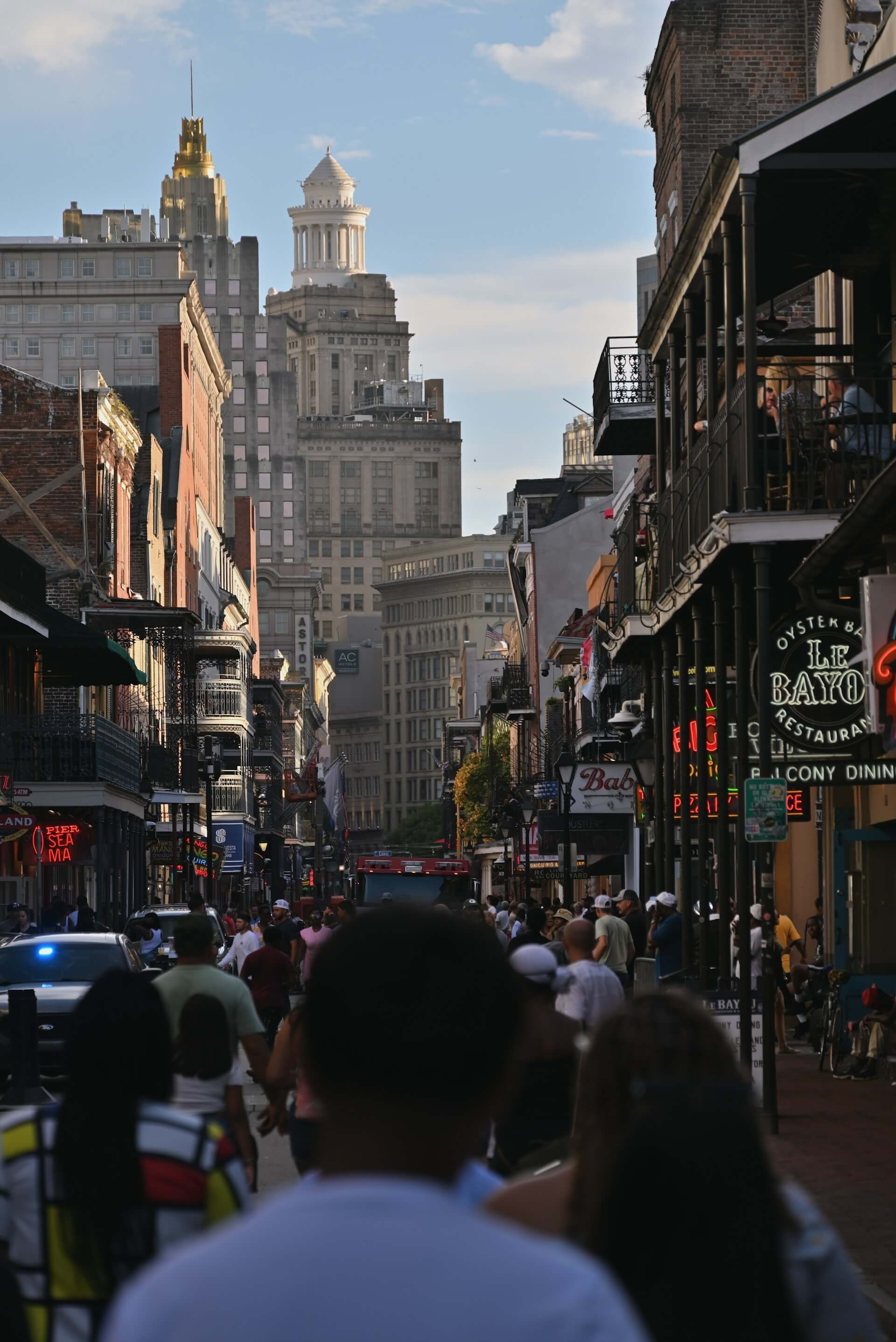
I’m on a streetcar headed toward the French Quarter, seated on the narrow front bench where everyone feels slightly more exposed. Almost as if by choosing to sit there, I’ve agreed to witness whatever comes and goes. My husband Art stands beside me, one hand wrapped around the overhead strap, swaying with the stops and starts, waiting for a seat to open.
Passengers board in uneven rhythms. First, a sunburned couple, then families pausing too long in the aisle, and other people unsure of where to stand or how far to move back. Tourists, most of them. We are, technically, the same, though it doesn’t quite feel that way. We’ve been coming to New Orleans for years now, long enough to move through it with some familiarity. Art used to live in Lafayette, and there’s a residual ease in him when we’re here, as if the rhythms of this place still register somewhere beneath the surface. It’s not belonging exactly, but it isn’t distance either.
Just across from me, close enough that I can hear him without turning my head, a man has taken it upon himself to narrate the ride. I don’t know his name, but something about him suggests it might be French. He begins with mumbled observations gathering force as more people step on. Commentary on manners, on hesitation, on the general decline of how people carry themselves in public. None of it entirely wrong, making it harder to dismiss.
“Why do people steal?” he asks, not to anyone, though the question lands in the shared space like it expects an answer. He doesn’t wait for one.
“Because they aren’t raised up right, that’s why,” he says. “Babies having babies.”
He shifts slightly, taking in the passengers as they settle, his gaze lingering on a younger man absorbed in his phone.
“These kids on their cell phones,” he continues. “If they spent half as much time reading the Bible as they do looking at those things, we’d have us a bunch of holy rollers.”
He lets that sit for a moment, as if satisfied with the diagnosis. Then, almost as an afterthought, or perhaps as a kind of signature, he adds…
But you didn’t hear that from me.
He’s dressed in black from head to toe, with a camel coat that’s seen better days thrown over it like a final gesture. Diamond rings flash on both hands when he speaks. There is a kind of residual elegance to him, the outline of someone who once moved easily in a different world. And yet at his feet sits a large plastic bag, the kind that once held a comforter, stretched thin and heavy with what appears to be everything he owns.
A hospital bracelet circles his wrist, visible when his sleeve falls back, an incongruous detail that refuses to be explained. He looks, unmistakably, like a man who has known prosperity and lost it, though not, it seems, the memory of how it felt to carry himself within it.
A hospital bracelet circles his wrist, visible when his sleeve falls back, an incongruous detail that refuses to be explained. He looks, unmistakably, like a man who has known prosperity and lost it, though not, it seems, the memory of how it felt to carry himself within it.
He speaks with the authority of someone who belongs here, who has decided that the streetcar, and perhaps the city itself, requires interpretation. There is a performance in it, certainly, but also something else. Not quite defiance or an invitation. Something closer to urgency.
At the next stop, someone rises, and the space shifts. Art moves instinctively, stepping forward before the gap can close. The man watches this small transition with interest, then gestures lightly toward the seat as if presenting it himself.
“The king now has a throne,” he says.
It is unclear whether he is speaking to Art, to me, or simply to the moment itself. But the phrasing lingers, just long enough to feel like more than a joke. Something about it reframes the scene not as inconvenience or irritation, but as a kind of temporary order. Roles assigned and reassigned without ceremony by the Jester.
At the next stop, the doors open with a practiced sigh. People step off, others step on, and the air shifts again. He pauses just long enough to register the movement, then turns to me, more directly this time.
“Where y’all been dining?” he asks, as if this, too, is part of his responsibility.
There is something about the question that feels less like small talk and more like a test. I answer carefully, aware now that anything we say may be folded into his larger narrative.
“Last night we had dinner at Mr. B’s Bistro,” I tell him. “We were sorry to hear the Palace Café had closed."
That lands. He nods, slowly at first, then with a kind of gathering certainty, as though we have proven something, not quite belonging, but at least an effort toward it.
“The Brennans,” he says, with a faint shake of the head. “All that infighting.”
The word lingers—infighting—and he seems to settle into it, turning it over, finding its shape.
“Family’ll do it every time,” he continues, almost to himself now. “Doesn’t matter how much money there is. Maybe especially then.”
Another stop. Closer now to Canal. The car fills, the noise rises, but his voice holds its place.
“My mother,” he says, shifting slightly in his seat, “she left most of it to me. I’m the baby.” A small pause, then, with something like pride: “That’s the Napoleonic code.”
He lets that sit, then turns it over.
“My brother—my greedy son of a bitch brother—he took most of it.”
There is no elaboration. Just the feeling of something stripped down to its grievance, carried forward because there is nowhere else for it to go. I tell him then that we’re planning to go to the Jazz Brunch at the Court of Two Sisters. That changes him. Not visibly at first, but something in the cadence of his voice softens, the edges rounding just slightly.
“Oh, I used to go there,” he says. “Me and my lover.”
The word arrives without hesitation, without qualification. He doesn’t look at us when he says it, just slightly ahead, as if watching something play out in front of him.
“We’d sit in the courtyard, listen to jazz,” he continues, “have brunch, and read the Wall Street Journal.”
He almost smiles at that, though it doesn’t fully form. The image hangs there in memory. Linen tablecloths, the slow turning of pages, a life ordered enough to include ritual. It feels intact in a way nothing else he has said does.
Another stop. The widening of Canal is just ahead now, the city opening itself in a different way. Inside the car, the present settles back in around him. The rings still catch the light. The coat still holds its shape. The bag remains at his feet. He adjusts slightly, as if returning from somewhere.
“Things change,” he says, not quite to us. And then, almost reflexively…
But you didn’t hear that from me.
The doors open again, and this time something in him shifts. He continues, but the thread is less linear now, more exposed. He says the illness took what he had left. Not all at once, but steadily. Piece by piece, until there was nothing to hold the shape of the life he had been describing. There is no self-pity in it, just a kind of blunt accounting.
Colorectal cancer, he says. It’s spread. He gestures vaguely, as if the body were no longer a precise map but a general territory in decline. There is mention, too, of HIV, though it comes without context, another fragment placed among the others.
“I don’t care,” he says, almost abruptly. “If I have to sell myself on a street corner.” The sentence trails off, then returns, quieter, almost correcting itself. “I wouldn’t do that anymore.”
He says he’s not going back to the hospital. The doctors can call if they want. He’s already made his decision. I feel it before I can fully name it. The awful awareness that I’m watching someone at the edge of his life, still speaking it into existence as it narrows into nothing. He turns to me again.
He says he’s not going back to the hospital. The doctors can call if they want. He’s already made his decision. I feel it before I can fully name it. The awful awareness that I’m watching someone at the edge of his life, still speaking it into existence as it narrows into nothing. He turns to me again.
“Where you from?” he asks.
“Austin,” I tell him.
The streetcar slows into Canal Street. We step off, and for a moment I feel the subtle disorientation that comes from leaving one world and entering another too quickly. Art takes my hand, instinctively, and we begin to walk, folding ourselves back into the current of the French Quarter.
He has gotten off as well. I didn’t notice at first, only the sound of his voice behind us, still carrying, still reaching.
“Hey—Austin.”
We turn. He is a few steps back now, the street is already beginning to move around him, people passing without looking. He gathers his bag, the coat still draped just so, the rings catching the same light they did on the streetcar. Without the contained space of the car, he seems less anchored, smaller and more exposed.
“You should try the Sea Witch,” he calls out. “Best gumbo in town.”
There is something in it. It’s a final offering, but also a reluctance, as if letting us go means letting the moment close. I smile and he smiles back. But not with his eyes. His eyes remain exactly as they were before. Heavy, a bit distant, holding words that no longer need to be said aloud.
We all stand there for a moment longer than we should. Then people begin moving between us, the rhythm of the street reasserting itself, and the man from the streetcar begins to recede.
As we walk away, I feel it settle inside, not sharply, but with certainty. I have the sense that what we have just witnessed is not simply a man passing through the day, but someone much closer to the edge of it.
Someone still arranging the fragments of his life into something that can be offered, even as it slips out of his reach. There is no way to know, of course. Still, I have the feeling that he won't be around much longer. And that, for a brief stretch between streetcar stops, he needed us to listen.
As we walk away, I feel it settle inside, not sharply, but with certainty. I have the sense that what we have just witnessed is not simply a man passing through the day, but someone much closer to the edge of it.
Someone still arranging the fragments of his life into something that can be offered, even as it slips out of his reach. There is no way to know, of course. Still, I have the feeling that he won't be around much longer. And that, for a brief stretch between streetcar stops, he needed us to listen.
But you didn’t hear that from me.




Comments
I thought about inviting him but it also felt like an intrusion- like he might mistake kindness for pity. After writing this, I wished I had asked his name, but maybe it’s better like this.