

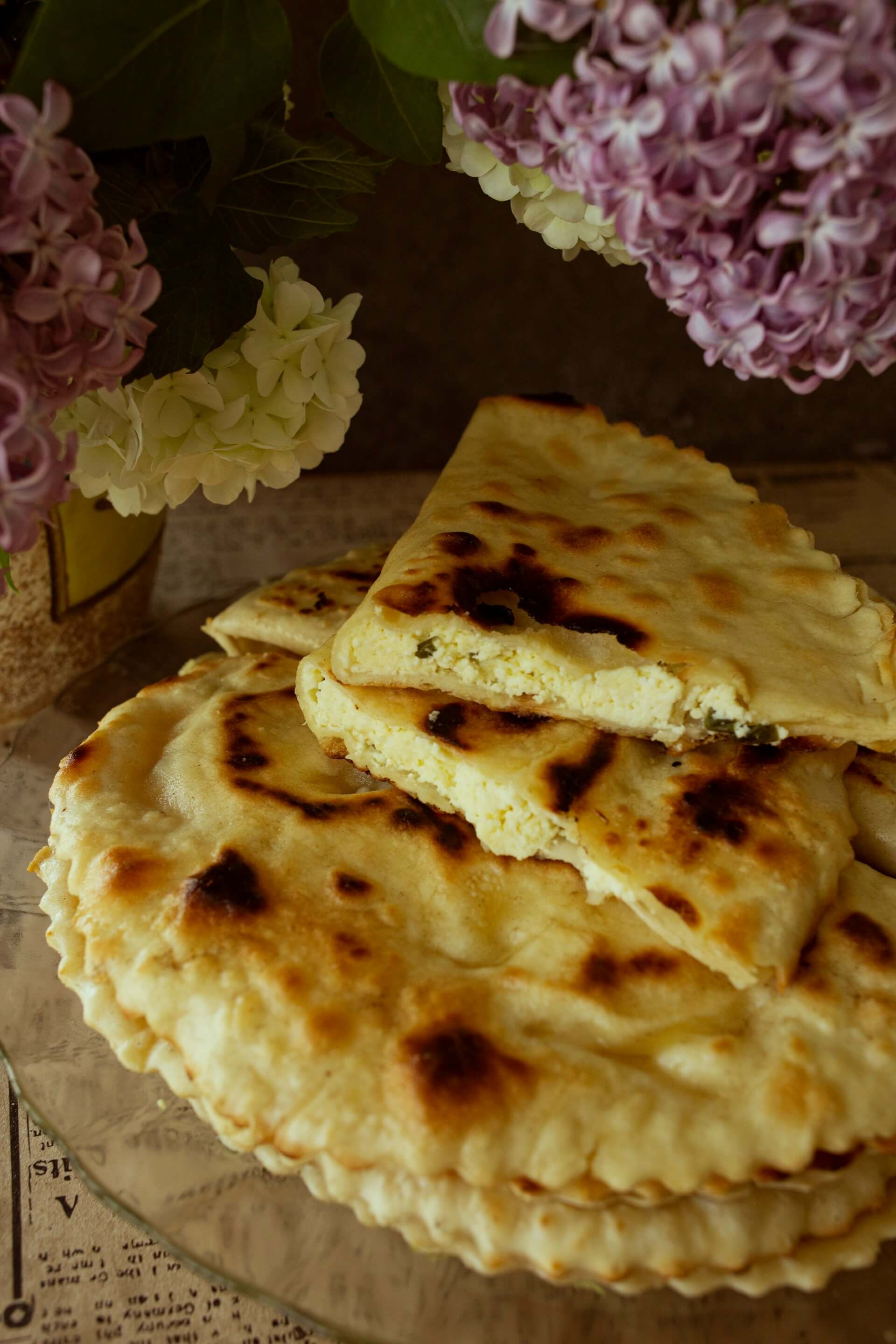
As an immigrant in a multicultural family in the United States, I love many types of dishes: tamales wrapped in banana leaves from my husband’s native state of Veracruz in Mexico, tacos al pastor sprinkled with Mennonite cheese as served in the Northern Mexican state of Chihuahua, where my husband and I worked with native Tarahumara people for years, rich smoked brisket as perfected in West Texas, our family’s home for the last two decades, and nearly every type of fresh cheese, pastry, salad, and roasted vegetable dish common in Eastern Europe, particularly those from my native Moldova. Of all the Eastern European dishes I love, there is one, however, that holds the greatest time-travel powers over me.
Every time I make plăcinte, I am instantly transported to my mother’s kitchen in our Soviet-style apartment in Moldova, my first home. Soft flour is spread all over the table and covers our hands and arms. My mother and I are standing elbow-to-elbow with rolled-up sleeves over our tiny table. She mixes the flour, sea salt, and creamy kefir and kneads the dough gently as I watch. We talk and laugh, and she crinkles her eyelids as she smiles and turns the dough over and over, pressing it in the large red bowl until it becomes smooth.
She covers it with a clean tea towel and then makes the filling: soft farmer’s cheese bought fresh from the neighborhood farmer’s market, finely chopped, bright green, crunchy, and aromatic dill weed and green onions, sea salt, all mixed together in a smaller tin bowl. She lets me do a taste test. I reach with a small spoon and try it. Mmm… Crisp, salty, creamy. Just right. I put the spoon in the sink and get my wooden rolling pin ready – this is my favorite part.
As my mother breaks the big chunk of dough into tiny balls with floury hands, she gives me one, and she takes one. We sprinkle flour on the table and place our balls on top, and then we sprinkle more flour. We each roll a ball with a rolling pin. My mother shows me how to do it in such a way that the dough stays perfectly round as it gets flattened and becomes thinner and wider until it gets to the size of a small plate. We add the filling and spread it on one half of the circle and fold it; now it looks like a semi-circle – I love participating in this magical transformation.
We fold the edges – my mom shows me how to lift, twist, and press so each placintă looks frumoasă (beautiful). After each placintă is made, we move it to a clean tea towel on the counter and cover it with another tea towel so it does not dry out. We continue making them until we run out of dough and filling. I count them. There are usually around two dozen.
My mother places a large pan on the old gas stove and turns it on using matches. She pours sunflower oil into the pan. When the oil is hot, she places the plăcinte one by one in the hot oil, and fries them on one side, then on the other until they are golden brown. She takes them out and places them on paper towels on a large platter for a few minutes. The kitchen is filled with yummy, warm smells. I love getting the first one that is ready, and I break it in half on my plate. Mouth-watering vapors come out, and I blow a few times. Then I bite.
Mmm... Crunchy and salty on the outside, soft, savory, lemony, and cheesy on the inside. Perfection. I close my eyes with pleasure. I have another one and another until both my belly and my heart are full. My mother calls the rest of the family to the table. I am full, but I have another one for good measure. They are always better when shared with family or friends. They taste good both cold and reheated, but they are best straight out of the frying pan served by my mother’s hands.
Plăcinte are forever linked to my mother’s hands, to her presence, to her love. They were our Saturday night comfort food and reward after a day full of chores. They were the snack of choice served with Moldovan red wine over a game of cards with our neighbors on Sunday nights. They were brought to the cemetery on Paștele Blajinilor, the Easter of the gentle ones, when we remembered and honored our loved ones who had passed away by sharing food with family and friends around the graves.
When my mother died five years ago, I made plăcinte with my daughter as I grieved. Soft flour, kefir, salt, dill weed, green onions, mixing bowls, and rolling pins filled my West Texas kitchen counter. My daughter helped me knead, roll, and fill the plăcinte, our arms covered in flour. We worked together until they were all golden brown and ready to eat. With every bite, I remembered my mother. I ate and ate plăcinte on that day and could not get enough. When I glanced at my daughter, she was closing her eyes with pleasure as she munched on the savory treats. “Good stuff,” she said and smiled. I knew my mother was nodding approvingly, a crinkle in her smiling eyes.

Comments